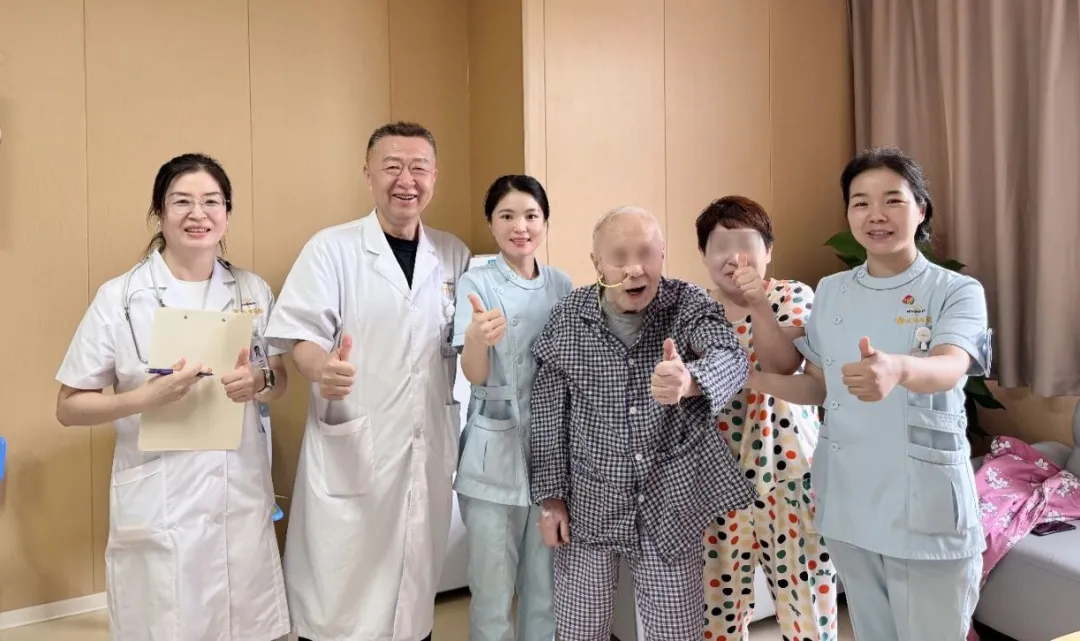
During ward rounds, the 86-year-old patient gives a thumbs-up to the care team at Chang'an Hospital, Xi'an.
Diagnosed with sigmoid colon cancer at 86, this elderly patient carried a burden few surgeons would accept: 90% coronary artery stenosis, interstitial lung disease, and Alzheimer's disease on top of the cancer itself. A giant tumor had grown until it blocked his bowel, subjecting him to the misery of bowel obstruction, while severe malnutrition left him extremely weak. Ultra-elderly, high-risk, and burdened by multiple comorbidities — he was, by every textbook measure, a refractory cancer patient.
Refusing to give up, the oncology center of Chang'an Hospital evaluated his condition as a whole and activated its multidisciplinary (MDT) mechanism. Experts from oncology, general surgery, interventional radiology, cardiology, imaging, pathology, respiratory and critical care medicine, and clinical nutrition discussed the case repeatedly. Their final decision: vascular interventional therapy — a treatment that requires no open surgery at all.
No Scalpel, Just a Needle Hole: How Vascular Intervention Works
In recent years, Chang'an Hospital has built a dedicated vascular interventional diagnosis and treatment system for tumors, recruiting Director Deng Youfeng, a renowned interventional expert in Shaanxi Province. Tumor vascular interventional therapy operates through the body's own blood vessels: under real-time DSA imaging guidance, a microcatheter is advanced through a pinhole-sized puncture directly to the tumor's blood supply for precise treatment. The wound is the size of a needle hole — minimal trauma, little pain, fast recovery — making it especially suitable for patients with mid-to-late stage disease, advanced age, frailty, or those unable to tolerate conventional surgery, radiotherapy, or chemotherapy.
"Cut Off the Supply, Then Strike": The Combination Punch
The interventional team performed inferior mesenteric artery angiography, tumor feeding-artery embolization, and local chemotherapy infusion in one session. Precise angiography first located the tumor's target vessels; then the team delivered a "cut off the supply + strike" combination — embolizing the tumor's feeding artery to starve it of nutrition while simultaneously infusing high-concentration chemotherapy drugs locally, achieving precise tumor suppression, local control, and systemic safety at the same time.
Back on His Feet — and Back to His Favorite Meal
After the procedure, the elderly man resumed normal eating, and within 24 hours he was up and moving around his ward as usual. When the care team came for ward rounds, he could not help giving a thumbs-up: "I never thought I would get through this — and still get to eat my favorite braised pork again."
"Tumor vascular interventional therapy needs no open surgery. Through the body's own vascular channels, a microcatheter reaches the lesion directly under DSA guidance — a wound the size of a needle hole, with minimal trauma, little pain, and fast recovery. It is especially suitable for mid-to-late stage, elderly, frail patients who cannot tolerate conventional surgery, radiotherapy, or chemotherapy."
A "Three-in-One" System for Difficult Cancers
In recent years, the oncology hospital of Chang'an Hospital has built a three-in-one diagnosis and treatment system — precise radiotherapy + targeted interventional therapy + individualized plans — together with a multidisciplinary MDT consultation model. With small trauma, high efficacy, and safety, it helps patients with complex, difficult, and critical tumors gain longer survival and better quality of life. This 86-year-old's recovery is living proof: age and comorbidity are no longer an automatic verdict.
Expert Profile
Director Deng Youfeng
Interventional Expert, Oncology Hospital of Chang'an Hospital (HYGEIA Healthcare)
A renowned interventional specialist in Shaanxi Province, Director Deng Youfeng joined Chang'an Hospital to lead its tumor vascular interventional program. He specializes in DSA-guided minimally invasive treatment — tumor feeding-artery embolization, local chemotherapy infusion, and related techniques — bringing effective options to elderly, frail, and surgically inoperable cancer patients.
Too Frail for Surgery? Minimally Invasive Options Exist.
HYGEIA Healthcare's international patient team can connect you with interventional oncology, MDT consultations, and individualized treatment plans across our nationwide hospital network.
Book a Consultation— Chang'an Hospital (Xi'an), HYGEIA Healthcare —
← Back to News