An Unexpected Discovery During a Routine Hospitalization
Recently, a patient was admitted to Suzhou Yongding Hospital for treatment of hypertension and coronary heart disease. During the hospitalization, doctors performed comprehensive examinations and discovered an abnormality in the thoracic aorta.
Further CTA (Computed Tomography Angiography) confirmed the diagnosis: an eccentric, irregular aneurysm in the aortic arch — with thin aneurysm walls, irregular morphology, and visible mural thrombus formation within the aneurysm sac.
The aortic artery carries blood under continuous pressure. Should the aneurysm rupture, the blood from this major vessel would surge out uncontrollably, rapidly causing hemorrhagic shock and threatening the patient's life.
Multidisciplinary Team, Minimally Invasive Precision Intervention
Facing this life-threatening emergency, Dr. Liu Jianjun, Director of the Interventional Vascular Surgery Department, rapidly organized a multidisciplinary consultation. Together with the anesthesia team, they developed a detailed and meticulous surgical plan.
During the procedure, the interventional vascular surgery team, under the guidance of senior experts, performed a minimally invasive endovascular repair — without opening the chest. Through vascular puncture, a covered stent was precisely delivered to the aneurysm location, isolating the blood flow impact on the aneurysm sac. Coil embolization was additionally performed to further reduce the risk of rupture.
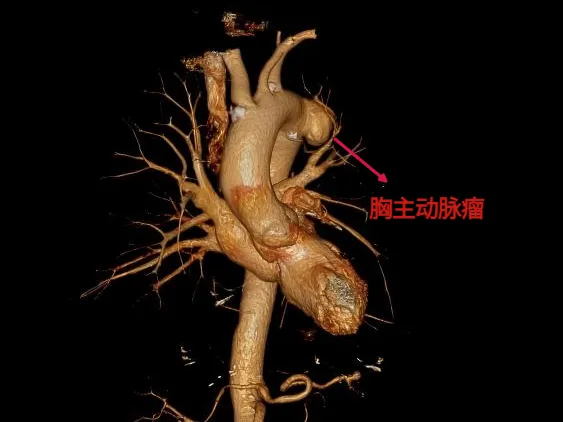
CTA 3D reconstruction revealing the thoracic aortic aneurysm (marked in red) — the thin-walled, irregular aneurysm with mural thrombus poses a significant rupture risk.
From the unexpected discovery to the precision "bomb disposal," Suzhou Yongding Hospital used a single minimally invasive intervention to safeguard the patient's life.
What Is an Aortic Aneurysm?
An aortic aneurysm refers to a localized or diffuse abnormal dilation of the aortic wall, where the maximum internal diameter exceeds 1.5 times the normal aortic diameter. While it may look like a tumor, it is not a true tumor — it is a vascular dilation. It does not spread or metastasize like malignant tumors.
Common Causes of Aortic Aneurysm
Aortic aneurysms are classified by location into thoracic aortic aneurysms and abdominal aortic aneurysms. Thoracic aortic aneurysms are further divided into ascending aortic aneurysms, aortic arch aneurysms, and descending aortic aneurysms.
- Hypertension and atherosclerosis — the most common causes
- Idiopathic degenerative changes in the aortic media
- Genetic disorders such as Marfan syndrome
- Congenital aortic malformations
- Traumatic injury to the aorta
- Infectious diseases affecting the aortic wall
Symptoms: The Silent Killer
Aortic aneurysms are often called the "silent killer" because most patients have no symptoms and are discovered incidentally during physical examinations or imaging studies for other conditions. Some patients may only realize they have an aneurysm when it ruptures.
Symptoms only appear when the enlarged aneurysm compresses surrounding tissues or organs. In some cases of abdominal aortic aneurysm, patients may feel a pulsating mass in the abdomen, or thin patients may observe abnormal pulsation of the abdominal wall.
Why Aneurysm Rupture Is So Dangerous
The aorta is like the main water supply pipe of the body. An aortic aneurysm is like a damaged pipe under constant pressure. As the aneurysm grows, complications such as pain, mural thrombus formation, and secondary infection may occur. If pain intensifies, it may signal imminent rupture. Once ruptured, regardless of location, the consequences are catastrophic — often leading to hemorrhagic shock and death.
How to Prevent Aneurysm Rupture
1. Maintain a Healthy Lifestyle
A healthy lifestyle plays a crucial preventive role. Regular moderate exercise, smoking cessation, limiting alcohol consumption, maintaining good sleep habits, reducing sodium intake, and controlling blood pressure and cholesterol levels all contribute to vascular health.
2. Regular Physical Examinations and Follow-Up
Regular physical examinations are essential for aortic aneurysm prevention. In the early stages, when the aneurysm is small and asymptomatic, the main treatment approach is close monitoring and regular follow-up imaging. Physicians should also pay attention to whether patients present with symptoms related to aortic aneurysm. Blood pressure control is critical, as is treating associated conditions such as diabetes and hyperlipidemia. Patients with genetic predispositions or congenital factors should be monitored especially closely.
3. Surgical Intervention When Necessary
For unruptured aneurysms, if symptoms such as chest pain, abdominal pain, or back pain appear; or if the aneurysm diameter reaches a certain size or grows rapidly, the risk of rupture increases and surgical intervention may be indicated. For already ruptured aneurysms, there should be no hesitation — emergency surgical treatment is required to save the patient's life.
Dr. Liu Jianjun
Vice Chief Physician, Director of Comprehensive Interventional Department
Expertise: Dr. Liu specializes in interventional treatment of tumors without surgical opportunity (liver cancer, kidney cancer, lung cancer, gastric cancer, colorectal cancer); peripheral vascular stenosis and occlusion; stroke prevention through intracranial and extracranial arterial stenting; acute cerebral infarction arterial thrombolysis and mechanical thrombectomy; intracranial aneurysm embolization; various hemorrhage embolization (postpartum hemorrhage, massive hemoptysis, gastrointestinal bleeding, traumatic bleeding); lower extremity venous thrombosis and pulmonary embolism; uterine fibroids and adenomyosis; diabetic foot intervention; and obstructive jaundice intervention.
Outpatient Hours: Thursday and Saturday mornings
Considering Vascular Intervention in China?
Contact HYGEIA Healthcare's international patient team to learn about our minimally invasive vascular intervention capabilities and expert teams across our hospital network.
Book a Consultation— Suzhou Yongding Hospital, Brand & Communications Department —
← Back to News